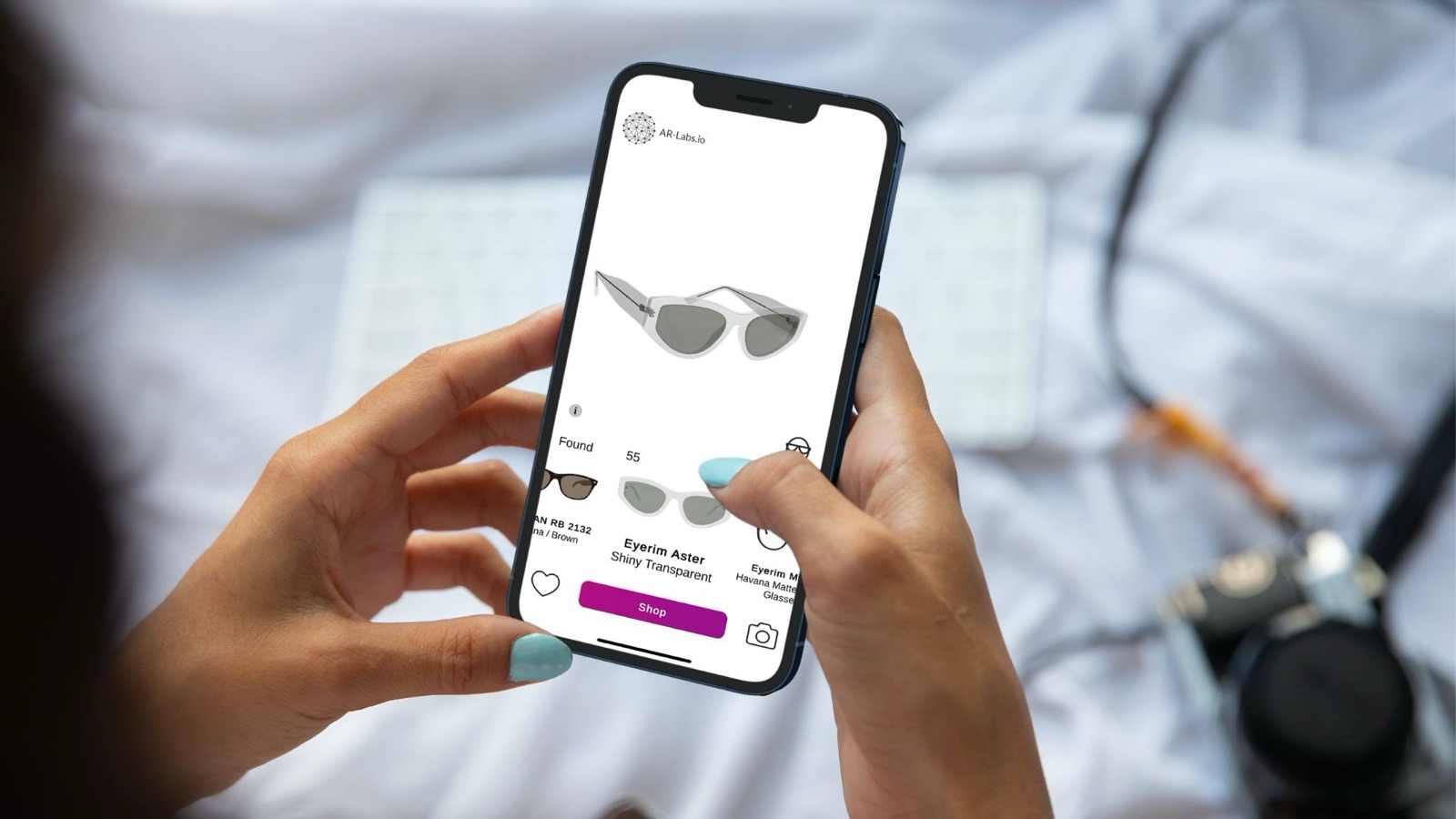
A few years ago, “virtual eyewear try-on” in an online store meant awkwardly pasting a flat 2D image of frames onto a photo of a face. The results were often unconvincing and did little to encourage a purchase. Today, Augmented Reality (AR) technology has completely rewritten the rules of the game in the eyewear industry.
If you’ve ever wondered how virtual glasses on a smartphone screen look so lifelike, or if you’re considering whether Virtual Try-On (VTO) technology is the right move for your store, here is how modern AR virtual mirrors actually work.
How does an AR Virtual Try-On work in e-commerce?
The process is intuitive for the customer and happens in real-time. When a user grants camera access in their browser, the AR system analyzes their face using advanced algorithms. In a fraction of a second, the system maps key facial landmarks: the distance between the eyes, the bridge of the nose, the shape of the cheekbones, and the jawline. This allows the technology to pinpoint exactly where the glasses should sit on the face.
Precise 3D Model “Anchoring”
Once the facial map is established, the system overlays a high-quality 3D model of the frames. The secret to a seamless experience is how the glasses “anchor” to the face, staying perfectly in place even when the customer tilts their head, looks around, or leans in. This allows customers to view the frames from every angle, just as they would in front of a physical mirror in an optician’s salon.
Photorealism and Light Interaction
Modern AR virtual mirrors do much more than just overlay an image. Advanced solutions simulate light reflections, ensuring that the frames look natural regardless of the lighting conditions in the customer’s room. This photorealism gives the customer confidence that the product will look exactly the same in real life as it does on their screen.
Why should you implement AR in your eyewear store?
Adopting AR technology is more than just a modern brand image—it delivers tangible business results:
- Higher Conversion Rates: Customers who “try on” glasses virtually are significantly more likely to complete their purchase.
- Reduced Return Rates: By choosing the right model online, customers are far less likely to return products, saving you time and logistics costs.
- Building Trust: AR in e-commerce helps overcome the biggest barrier to online shopping: the inability to see or test a product before paying.
Seamless Integration with AR-Labs.io
Many store owners fear that implementing such advanced technology is a months-long technical project. At AR-Labs.io, we prove that it doesn’t have to be. Our solutions, based on lightweight widgets, allow you to integrate a Virtual Mirror into your store in just a few minutes, with no need for a website overhaul or expensive IT specialists.
AR technology has evolved from a futuristic gimmick into an industry standard that helps opticians drive sales and build stronger relationships with online customers.
Want to see how an AR Virtual Mirror from AR-Labs.io can transform your store? Don’t wait for your competition to take the lead. Reach out to us today to learn more about our services.
📩 Email us at: letstalk@ar-labs.io
🌐 Check our FAQ at: https://ar-labs.io/faq